

My Journey from Engineering to Consultant
How I became a consultant to help clients build strong platform engineering teams...and how a consultant can help yours

Recently I've had several people reach out asking about my career in consulting, and I thought why not share those insights via post so others might benefit.
Because of a career in consulting, I've managed to gain unique experiences including:
Becoming a LinkedIn Learning author for courses in DevOps, Azure, and Blockchain.
Guided a client on $1B digital transformation in the mining industry
Supported a US university in establishing a program for carbon capture within the energy sector
Being an early adopter with technologies including cloud (2012), big data (2011), blockchain (2017), the list goes on...
Successfully delivered project with key global data insights for a client that had fired 7 previous consultancies
Helped a board negotiate with a rogue CTO that was withholding IP
Led teams in 50+ cities gaining insights on various cultural intricacies and patterns
Designed a solution to provide product level insights for net zero measurements across supply chains
Had the opportunity to support some of the largest brands in the world including Electronic Arts, Microsoft, Accenture, and many others in the Fortune 500.
I will admit writing them down it seems an impressive list (I've never really thought of it that way before); they have been rich experiences and I'm thankful for the opportunity. I haven't gained these experiences by sticking to a defined path, I've carved out these experiences taking a rather unique approach, even going independent to make sure I could continue to cultivate these.
Changing definition of a consultant
These days the term consultant can be used to describe a multitude of people - new graduates hired by established consultancies, individuals working only with a single client (in essence a permanent contractor which should be an employee position), and even freelancers who may lack industry-specific experience but offer services under the title of "consultant." This shift in terminology has broadened what it means to be a consultant but also blurred the lines between true advisory roles and entry-level positions or contractual work.
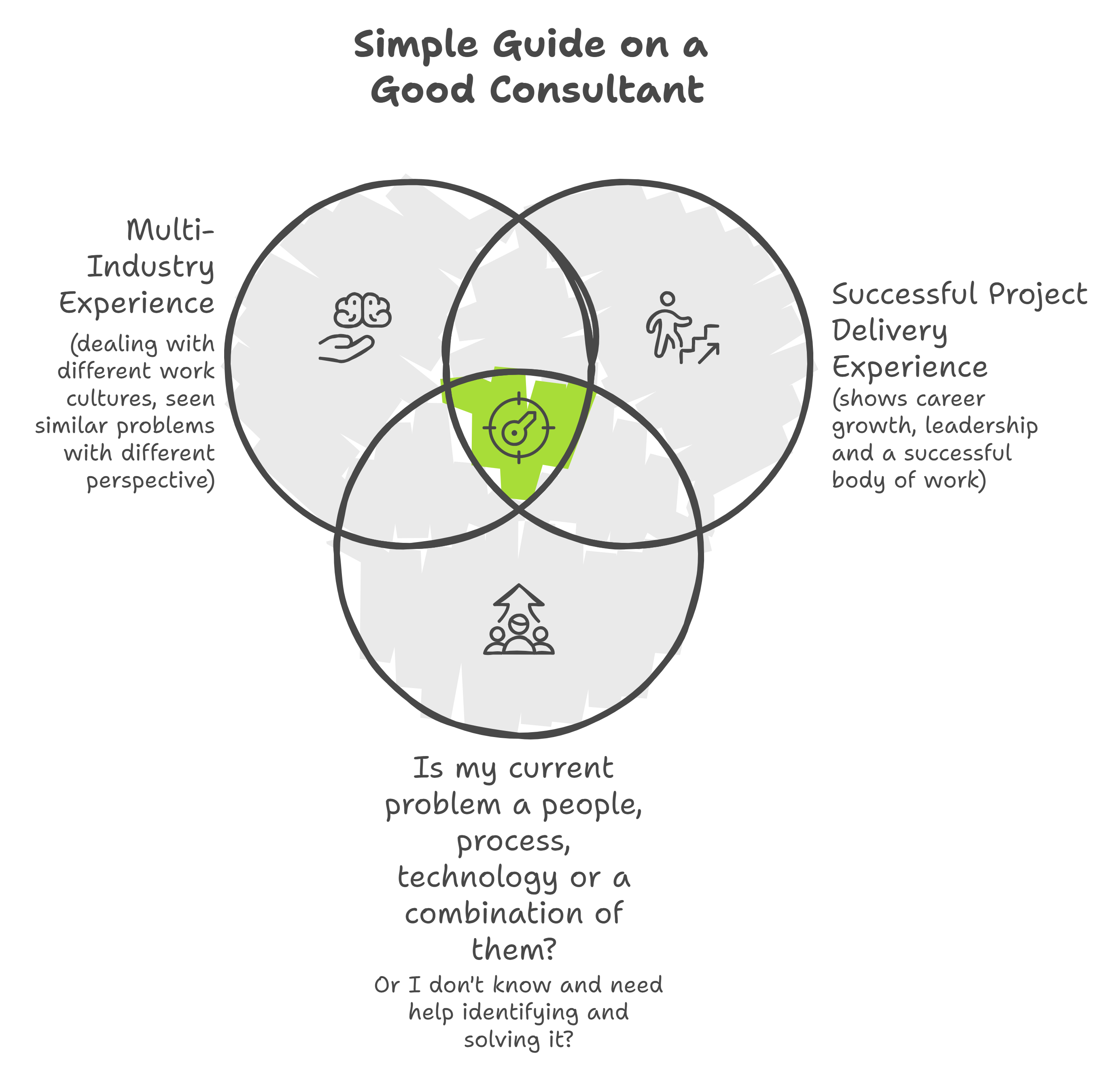
Early on in my career, a consultant was someone senior in their role and had lots of industry experience - that translated well into them being able to advise others. I mostly agree with this perspective. To be an advisor, yes you need to have a extensive work experience along with that work experience in multiple industries. The advantage to multiple industry experience is that you can see similar patterns of problems, transfer solutions and most importantly show trust that you are capable of getting a job done.
My multi-industry experience is a large part of the reason I went independent after over 10+ years of being in the industry.
Why does anyone need a consultant in engineering?
So the common question that comes up is, "Why does anyone actually even need a consultant in engineering?"
For any project to be successful, there’s three factors that need to align: people, processes, and technology. A the goal of a consultant is to advise, guide or provide some expertise (with the advice/guidance) meaning the level of consultant you need depends on the maturity/state within the organization. Early stage companies will often use contractors to offset a lack of internal resources.
As the organization matures the business gets engineers in-house, and they’re handling a lot of that workload. Organizations begin to look at building capability within their teams, benefitting from maturity within processes. Internal teams will typically be strong technically, they will understand landing zone architectures, Infrastructure as Code, Kubernetes, package management, and most technical aspects.
At this stage, you will benefit from a consultant that will bring maturity into processes, and often times even change team structures to align with the project/corporate vision. You're looking to bring in someone that enables organizational change, so that you can start join the DORA elite performing group.
Typically these types of changes are driven by organizational wide initiatives such as responding to new competition, mergers and acquisitions, building cyber resilience, you get the idea. For scale-ups this can be a situation where the team needs to mature and there isn't budget to bring in additional fulltime resources yet.
The counter argument is "Why not just hire a VP of Engineering and get it over with?" Yes, a VP of engineering is needed to maintain operations, but organizational change can be daunting and that person may not have the capacity to deal with it. A consultant can come in to minimize risk for the business in this time of significant shift, provide access to network, accelerate timelines, and provide a clean perspective that isn't available internally. They become partners for leadership to help bring maturity, often times leadership roles are changing as well and they can benefit from having a sounding board before making significant decisions (supporting in a coaching capacity).
A recent (good example) where a consultant (me) benefited a client was creating and executing cybersecurity strategies and initiatives across platform engineering heavy teams. Leadership knew the importance of this initiative but had not being able to drive any internally lead changes and this is where they asked me to step in. In this team, as often is the case in most platform engineering teams/developers, they were not keen on implementing some of the changes for a multitude of reasons including lack of desire or seeing value, "slowing down delivery" and even a lack of knowledge on the how. By me coming in I was able to:
Distill what was needed and what was noise to achieve leadership goals
Help bring setup some new metrics and processes that can help achieve the clarified goals (using proven practices)
Guided and provided coaching to managers and training to teams
Help build long term sustainable capacity for the client then to manage going forward.
After this 1 1/2 year long engagement, I exited the client from a day-to-day involvement and became available on retainer. Not all engagements require full-time access, in fact most only need part time support. As a consultant, part of our goal is to work ourselves out of the day to day and hand off the knowledge to internal resources. Clients appreciate that support and often makes for repeat customers.
With DevOps consulting the right consultant will leverage existing teams, introducing benefits to application guilds, repositioning the teams to consider risks during the planning and design phases when it's considerably cheaper to address. In my case, in a consultant capacity, I'm not bound by organizational hierarchy so I can introduce necessary changes, and often I find teams are more perceptive as they understand the commitment across the organization. Part of it as well, they feel heard, and I introduce those feedback mechanisms into management so it's not just top down approach.
Why did I become one?
I got into consulting because I was interested in helping clients to solve problem. I could work with many clients at any given moment (my highest number is 6 at once) and I am not bound to a single organization, or a single location. The experience I gain as a consultant now just compounds and makes better so that I can help teams better and faster.
I have always been fascinated by solving technology problems since I was a kid. Whether it was to get EA's NHL running on a machine that was woefully underpowered when I was a kid (I did get it working) or building performance driven systems as an engineer I am always happiest to solve problems and watching the success. The next logical step for me was to get consulting because I can work with many clients at any given moment (my highest number is 6 at once) and I am not bound to a single organization, or a single location. The experience I gain as a consultant now just compounds and makes better so that I can help teams better and faster.
There are future articles that will deal with "the day in the life of" or "the downsides" for aspiring or existing consultants, but what I am curious to hear from you about is this:
" What has your experience been hiring or being a consultant? Good or bad, I want to know...comment below"