

Building Industry for CleanBC's 2030 Green Transportation Goals
Reinventing Uber for a green future

The CleanBC Roadmap to 2030 commits to meeting 100% of emissions targets across 8 different pathways making commitments in transportation such as BC's Electric Highway with 10,000 public EV charging stations by 2030. I would argue BC is missing the opportunity to establish global leadership in personal transportation and looking at the wrong metrics.
Below is the commitment made by BC on sectors that need to be established for our 2030 goals. Notice how Personal Travel is second to green electricity.
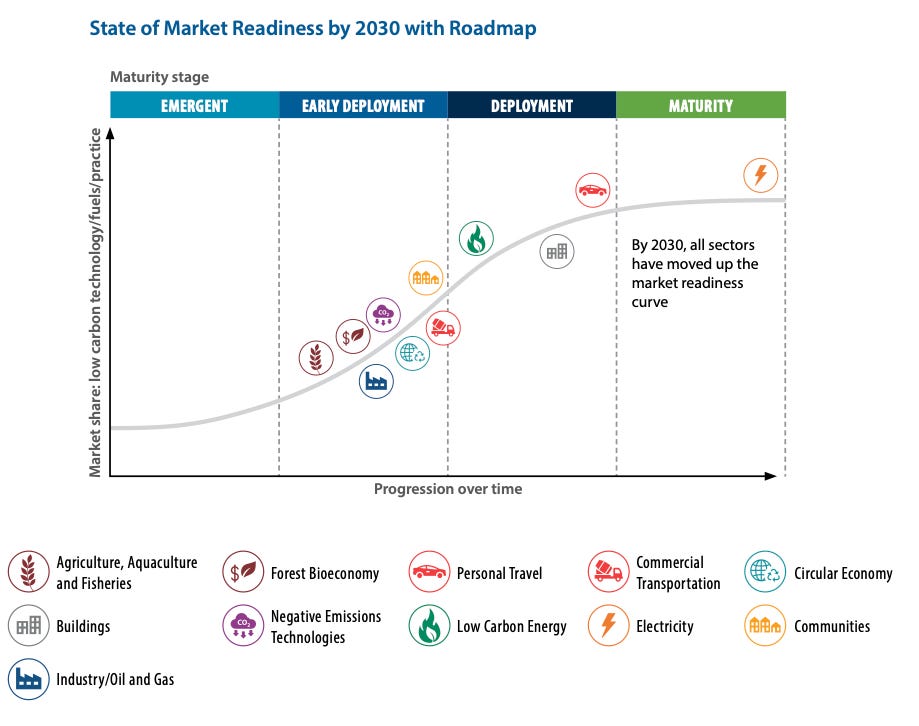
The issue is Personal Travel seems to focus on primarily electrification and Zero Emission Vehicles (ZEV). We have a unique opportunity to become a leader in MaaS, reinventing the traditional travel model to meet modern needs. Imagine a future where reaching your destination is seamless, sustainable, and smart, regardless of the mode of transportation.
It's time we created a homegrown industry to reimagine Uber model. Uber sparked a transportation revolution but didn't fully realize its potential, stopping at car rides. Now, it's time to move beyond and imagine a comprehensive MaaS system that prioritizes sustainability and efficiency. Let's explore this exciting vision for the future of green transportation in BC and beyond.
How BC is positioned to dominate MaaS
Canadian government has made large green energy commitments, and BC has close to 100% of our energy from hydro power. I think there's an opportunity to invest in alternative green energy sources; arguably we could sell a green energy blueprint to other provinces that are heavily traditional energy and resource dependent (looking at you Alberta) - but that's a topic for another discussion.
Personal Travel is an issue that needs to be resolved within BC, as housing prices in core urban areas are some of the most expensive in North America. It translates to population needing to move to peri-urban areas, where they are further away yet close enough to be in the city.
We can see this in the numbers, the population in BC is about 60/40% for urban vs rural respectively, and since 2010s rural growth has started to increase. Tied to that we have several benefits in this province that make rural growth necessary - access to ports (Asia Pacific Trade), access to lots of land, some of the cheapest electricity it means we would be great for data centers. But none of this is possible without easy access to more urban areas.
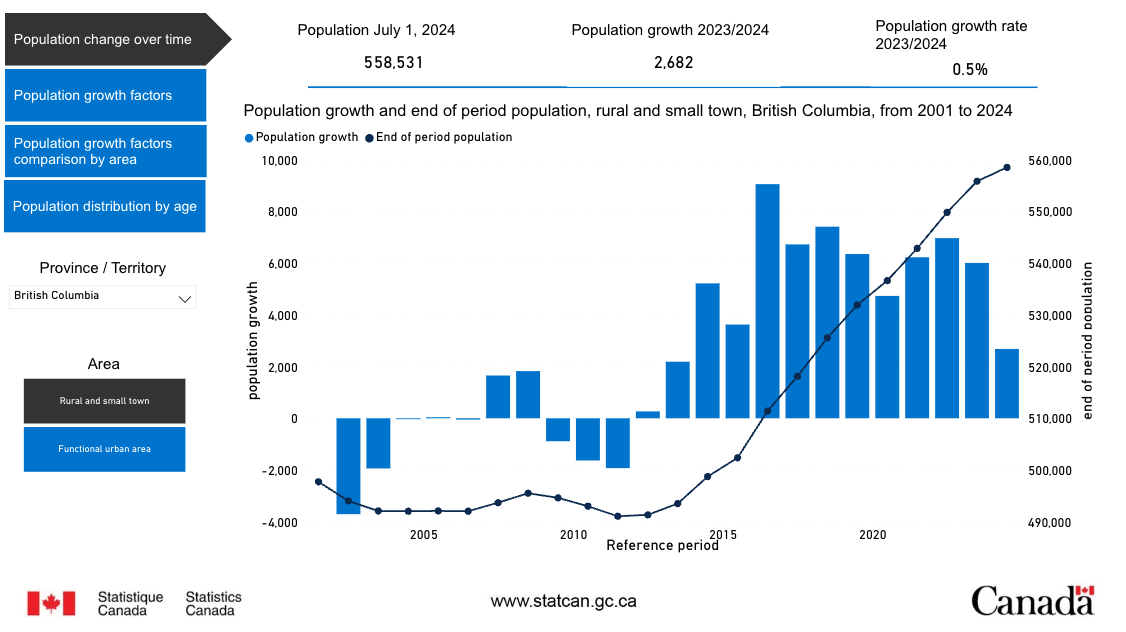
Source: https://www150.statcan.gc.ca/n1/pub/71-607-x/71-607-x2021030-eng.htm
While BC’s landscape is stunning, it's complex to serve with traditional transit. Outside the dense Metro Vancouver and Victoria areas, communities are often separated by mountains or water. Coastal communities like the Sunshine Coast or Gulf Islands rely on ferries as lifelines – there are no road or rail links. Interior towns can be hours apart along winding highways. This geography leads to heavy personal vehicle use; rural and remote residents often have no alternative but to drive long distances. Even within urban regions, natural barriers (like Vancouver’s surrounding ocean and inlet) concentrate traffic onto a few bridges and create congestion.
Green transportation is a problem we need to solve. It's not a problem that's unique to BC, and by solving the problem we can export the solution globally. Our ZEV targets align with California but imagine selling our homegrown solution there to the 5th largest economy in the world. They have many of the same problems and our geography means we need to solve those problems anyways which would translate to an easier adoption.
BC also happens to be a leader in the cleantech industry. According to Cleantech Group, we have 7 of the top 100 global cleantech companies here in BC, so going green is in our backyard. Our hardware and engineering R&D has always been strong, but BC has not leveraged the raw software engineering talent here that could be put to focus on a software solution tying many of these solutions together.
Why MaaS is the solution
If you're living within a peri-urban region, the primary option for transportation is vehicle based. I would know - over covid I moved out of the city and was forced to purchase an additional vehicle as it was the most reasonable option.
So, what would it take for someone like me to adopt a MaaS solution?
A single cohesive app - while TransLink has begun work in this space, it has a limited radius and doesn't service peri-urban areas well. For instance, I need to take a ferry but that's not included within the current app. Car-sharing & bike sharing services are similarly limited.
First/Last-mile solutions - The trickiest part for me is getting to and from ferries, any solution needs to address this. Partnering with private micro-mobility services such as e-bikes and e-scooters along with public transportation services would provide excellent coverage. Additionally, the service should cater to ride pooling to calculate and make the process similar. If many people are travelling to a common destination such as downtown Vancouver, they should be able to coordinate via the app.
Unified payment and green incentives - Having a single point for payment & rewards could align all transportation mechanisms to reward sustainable choices.
I love to drive as a hobby, but for a commute to work it becomes a chore. When travelling for work, I prefer modes of transportation that allow me to focus with peace of mind and no added stress. It's often why I use train transportation in Europe, it's wonderful I can work and not have to worry about traffic.
The vision of a MaaS service is to unite remote communities with urban centers allowing for the greenest possible modes of transportation. We need to provide people with multiple options for transportation, uniting public and private services, and rewarding people for selecting sustainable options. These are problems that need to be solved globally and we could be the test bed to validate it. A key benefit of this would be to allow private corporations to sell such services globally thus creating a model that would help BC tackle it's deficit issues.
Where Government support is needed
Policies and regulations could support establishing this industry by providing a framework that encourages innovation and integration. We need policies to align consumer behavior with sustainability goals, incentivizing greener choices and supporting the growth of the green transportation industry. A few areas to consider
Integration and Data-Sharing: We need to mandate open data standards focusing on interoperability providing real-time information for decision making and encourage integration of these into all services. For instance, transit, ferry, and private mobility services each have separate payment systems and data silos.
Focus on established cybersecurity standards for critical infrastructure: With nation state actors trying to disrupt other Canadian critical infrastructure services, it's not a far throw to imagine what open data opportunities would enable for hackers. Any services adopting these standards need to have sufficient cybersecurity.
Rural and Inter-city Service: Current regulations and funding do little to ensure connectivity for rural areas. When Greyhound and other private coaches pulled out, no strong policy response filled the void, leaving fragmented regional services. A regulatory strategy (and funding) to support inter-city bus or rail as an essential service is lacking. The forthcoming federal Rural Transit Solutions Fund is a start, but without sustained support or coordination, rural Canadians remain car dependent.
Implement Smart Pricing Mechanisms: To align behavior with sustainability, introduce pricing reforms. For instance, allowing municipalities to implement congestion charges or tolls in downtowns (with revenue recycled into transit improvements); encourage usage-based car insurance and parking pricing. What would help even more would be standardizing mechanisms to how pricing between public & private services be aligned, as a user you only must worry about a single price in the app, and it would divvy out payments.
Innovation and Technology
Technology is the glue that will enable these services and arguably spawn a new industry. Vancouver's TransLink RideLink is a great start but doesn't get us far enough. Let's explore a few technologies that could support this vision, where it's already adopted, and how they might transform the transportation experience.
Artificial Intelligence: These days everybody seems to be mistaking LLMs for AI, there are lot more interesting use cases. We could apply dynamic decision making in traffic optimization moving towards smart traffic management and connected vehicles. Montreal is rolling out such a system to adjust traffic lights based on incidents, feeds, and sensor data. The goal here being to optimize traffic flow. These should be integrated with other core services; imagine reducing the risk for ambulances in emergency situations by adjusting traffic patterns. We could also use AI chatbots to plan routes based on commuter preferences.
Digital Twins: using IoT sensors to monitor conditions in real time and simulate potential scenarios optimizing for sustainability targets. This could help with congestion management and providing alternative plans. It could even help build the case for additional infrastructure. YVR has adopted this type of system precisely for these use cases.
Design for integration: The last piece is less of a technology but a design element, this type of system needs to be designed to allow 3rd party private transportation providers to coordinate and that's a big lift. The benefit would be integration with smart traffic management with public services such as buses, trains, ferries to micro mobility solutions to private services including Uber drivers, taxis, etc.
BC has an opportunity to build the Uber of tomorrow, that combines commuter's needs, municipal requirements, and builds towards a greener future. Now is the time to capitalize on it.